
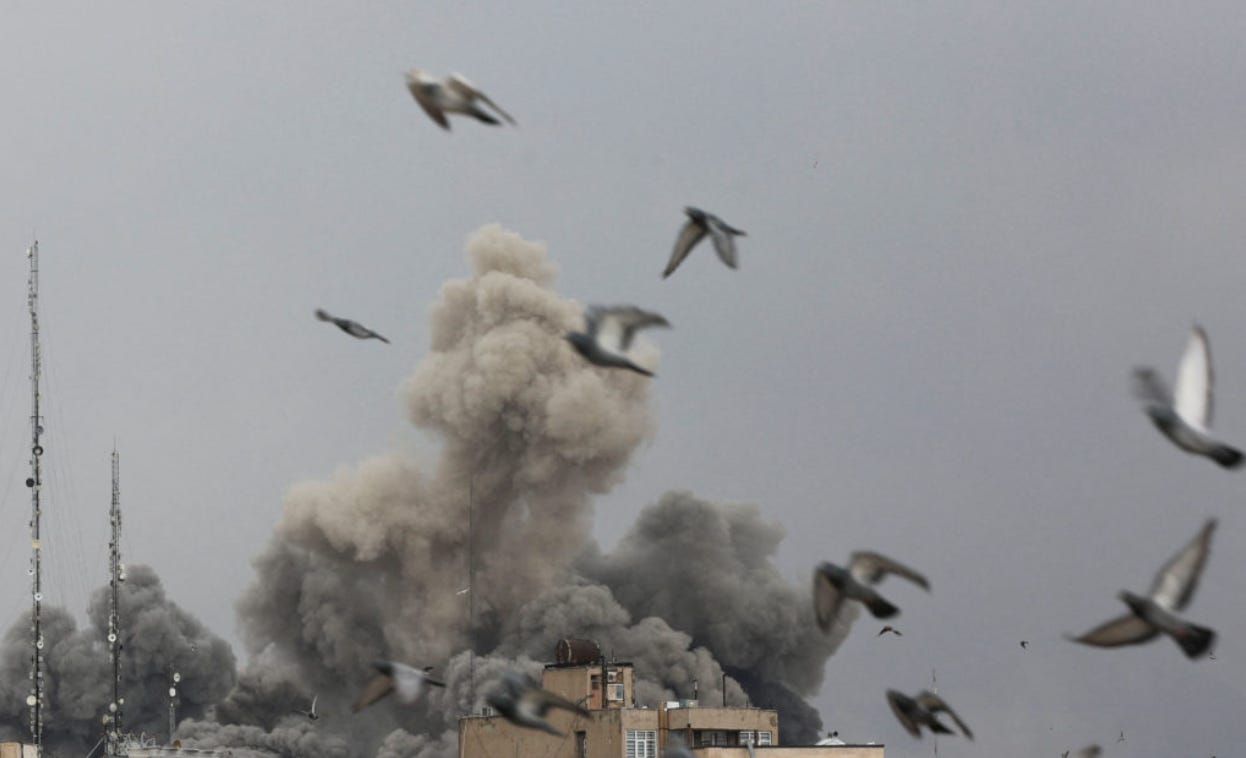
Of all the military adventurism America has engaged in since the end of the Cold War, this morning’s attack on Iran is surely the most baffling, and its aims the most poorly-formulated.
It may be that, as US and Israeli warplanes bomb targets around the Iranian capital Tehran, this is merely an attempt to push the Mullahs back to the negotiating table. But it is looking more and more like an attempt at full-on regime change.
There are three major demands that Washington has made in recent weeks of Tehran as it built up its forces in the Gulf.
The first was that Iran halt its effort to make nuclear weapons; the second that it stop supporting militant proxies in the region; and the third that it decommission its missile programme.
But none of them made much sense.
According to Trump himself the first aim had already been achieved last June when Israel and America launched a 12-day bombing campaign against Iran’s major nuclear facilities and - in the words of the White House - ‘obliterated’ them.
The second stated aim has also largely been achieved. Hezbollah in Lebanon, Iran’s most important proxy, was largely destroyed by Israel in 2024, it’s leader Hassan Nasrallah killed in a bunker in Beirut.
Meanwhile Syria’s Bashar al-Assad was overthrown by the America-friendly Ahmed al-Sharaa and his Alawite regime has been destroyed. The Houthis in Yemen are on the back foot.
The final demand of Tehran was that it give up its missile programme. But that represents the Mullahs only serious military capability in a region that is armed to the teeth and chronically unstable.
In the same way that Saddam Hussein was unwilling to disarm ahead of the 2023 invasion, sensing that a defenceless Iraq would be picked off by its neighbours, Tehran will have made the same calculation.
In a Truth Social post Trump said he was “undertaking a massive and ongoing operation to prevent this very wicked, radical dictatorship from threatening America and our core national security interests.”
But the Islamic Regime, which is at its weakest since the Islamic Revolution of 1979, represented almost no threat to America.
So has Trump then ordered the attack to help the long-suffering Iranian people?
When hundreds of thousands took to the streets in late December and the Revolutionary Guard gunned them down - as many as 30,000 may have died - Trump did promise volubly that he would come to their aid.
The notion that if you decapitate a harsh regime the locals will be forever grateful is a banner that was waved by George W. Bush ahead of the ill-fated US invasion of Iraq in 2003.
But positing Trump as a humanitarian who is acting in the interest of the Iranian people is a laughable proposition.
What then has been the American president’s calculation as he slowly built up military capacity in the Arabian Sea?
The most likely explanation - and as ever with Trump psychology is probably a better predictor of his actions than policy - is that he simply thought he could bully Iran into presenting him with an easy win.
In business if you line up overwhelming force and explain to your opponent the cost of not submitting, they will probably back down.
But business deals are not life-and-death. The developer who withdraws a bid on a coveted piece of real estate gets to go home at the end of the day to his family.
The Mullahs, by contrast, will see this showdown with the United States as one that threatens their very existence. It is both in their DNA, and probably even logical from their point of view, to fight this one to the bitter end.
So if there is no discernable advantage to the US from this war who does get to benefit? The Saudis - who have been sworn enemies of Tehran since the Islamic Revolution - were certainly not in favour.
They point out that opening Pandora’s box in the Middle East can lead to years, sometimes decades, of destabilisation and immense numbers of casualties. (See here for my post on the risks of an ethnic civil war in Iran.)
Between 2003 when the Americans invaded Iraq, and 2011, when they mostly withdrew, up to a million Iraqis died as well as 4,500 American serviceman. ISIS then took control of much of the country.
So what about Israel? To hear it from Benjamin Netanyahu defanging Tehran would be a huge strategic win for the Jewish State.
But Netanyahu said the same in 2003 about Iraq, claiming that taking out Saddam Hussein would usher in an era of democracy and peace in the Middle East. Instead we saw two decades of war.
If that were all not enough there are the hard lessons of Afghanistan.
The US and its allies battered the Taliban into submission only to see that effort morph into a 20-year civil war in which thousands of western servicemen died and billions of dollars were wasted. Eventually the very same Taliban returned to power.
Perhaps, then, the best explanation for Trump’s decision to attack Iran is the simplest one. Like Netanyahu, and Vladimir Putin, Trump is a strongman with a powerful military at his disposal and he just can’t resist using it.
But such thinking is egregiously shallow and short-term.
Netanyahu may have defeated Hezbollah and Hamas - sworn enemies - but Israel’s barbaric methods in Gaza have probably left it as the most hated nation on earth, something that is surely not good for its long-term prospects.
According to a poll that came out this week, US voters - the last major bastion of international support for the Jewish state - registered more sympathy for Palestinians than Israelis for the first time.
Ironically one aspect of Trump’s character that may yet save him from the worst consequences of his decision to attack Iran is that he has very little appetite for follow-through.
Putin has bled his country dry because he cannot bring himself to give up on his foolhardy decision to attack Ukraine in 2022.
Trump has shown no such proclivities. He tends to dump anything that even hints of failure like a hot potato.
Trump then - unlike Bush in Iraq and Obama in Afghanistan - is unlikely to double down if things start to go wrong. He will probably blame someone else and move on.
As someone who spent years of my professional life watching at ground level as US deployments did go horribly wrong - that is probably a good thing. But right now it is a spot of lighter grey in a very dark sky.
Attacking Iran would certainly seem to be a foolish and ill-considered decision. Predicting the final outcome is, of course, impossible. But it is difficult to imagine it improving the lot of those in the Middle East - or beyond.
I would strongly argue that (as is generally the case in wars in the Middle East) that this is primarily about access to oil.
Iran has the heavy crude required to blend with lighter fracked oil to make the full spectrum of petrochemical products, but most importantly diesel, which is the lifeblood of this civilization.
On that note, it has the advantage of cutting off China from their last remaining heavy oil supply (since Venezuela is no longer an option) and constraining their future growth.
Typical US imperialism.
And the wag the dog scenario.